

REFLECTION
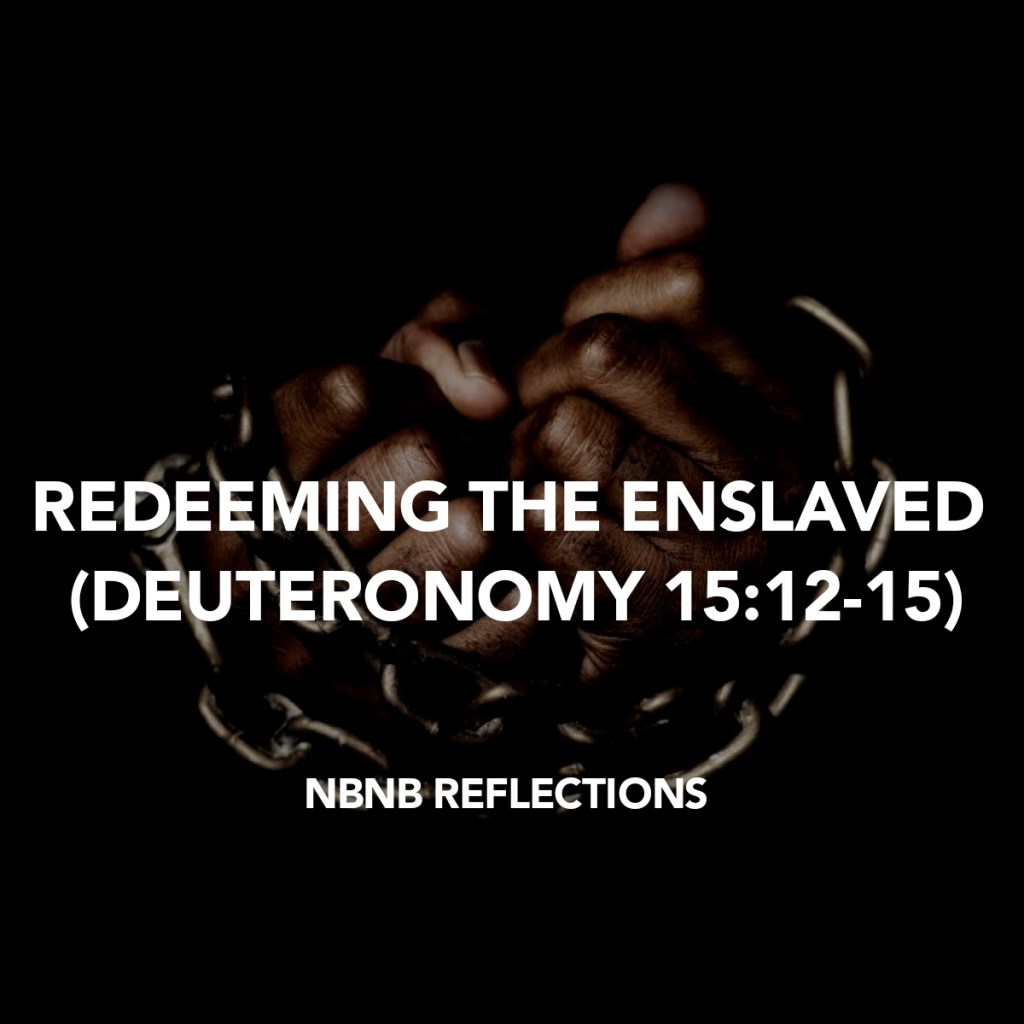
Redeeming the enslaved is the theme for our reflection. To redeem means to release from distress or to release from bondage. Enslaved means to cause someone to remain in servitude. Redeeming the enslaved means liberating a person who has been in servitude for a considerable number of years. In ancient Israel the were two types of servitude or slavery. An Israelite can either purchase a foreigner as a slave or an Israelite who is poor and is indebted to a fellow Israelite could go into a contract of paying off his or her debt by working for his or her creditor. Again, an Israelite who owes someone could also go into servitude or become a slave of another Israelite to pay off his or her debt. An Israelite who finds himself or herself in servitude’s dignity is protected by law. The law or command is that “If any of your people—Hebrew men or women—sell themselves to you and serve you six years, in the seventh year you must let them go free. And when you release them, do not send them away empty-handed. Supply them liberally from your flock, your threshing floor and your winepress. Give to them as the LORD your God has blessed you. Remember that you were slaves in Egypt and the LORD your God redeemed you. That is why I give you this command today.” (Deuteronomy 15:12-15). In other words, one cannot keep a fellow Israelite enslaved for more than six years. The enslaved person must be liberated in the seventh year and well compensated for the services rendered to enable him or her to become economically independent after the number of years in servitude.
Beloved in the Lord, in the twenty-first century servitude or slavery still exist in different forms. Slavery could exist in a master-apprenticeship and an employer-employee relationship. Similarly, servitude may occur between a benefactor and a beneficiary. There are many Christian masters, employers and benefactors who have poor and vulnerable people working for them. The relationship must be such that a believer or Christian must respect the dignity of those who work or serve him or her. We must adequately compensate the underprivileged or poor who work for us. The aim is to help such people to become economically independent in the near future. The fundamental principle governing the commandment of redeeming the enslaved is the golden rule. Jesus admonishes us that “So whatever you wish that others would do to you, do also to them, for this is the Law and the Prophets.” (Matthew 7:12).
A Christian politician or leader’s faith is incomplete if he or she is a beneficiary of an economic system that enslaves the poor and makes so much from them without proper compensation for the work they do. Unfortunately, we belong to a world where the rich possess the authority to govern and make policies that affect the poor adversely. Some private companies owned by Christians fail to properly compensate their workers for long hours and overtime jobs and for the many years of service. Some Christian contractors have used their workers for many years without adequate compensation. The dedication or selflessness of these workers or subordinates has helped these contractors to become wealthy yet they fail to adequately compensate the men and women who continue to contribute to their success. Sadly, some go home impoverished with all manner of health issues as a result of working in a hazardous environment. God is never pleased with us when we refuse to redeem those we have systematically or deliberately enslaved but rather continue to make so much wealth from their blood and toil. Paul admonishes us that “Masters, treat your bondservants justly and fairly, knowing that you also have a Master in heaven.” (Colossians 4:1). If Paul were to be in our era, he would have written, “Employers or bosses treat your employees or subordinates justly and fairly, knowing that you also have a Master or a Boss in heaven”. Regardless of how generous we are to the church and how committed we are to the financing of church projects, no matter how prayerful and punctual we are to church programmes or activities, so long as we have refused to redeem those we have enslaved, God is not pleased with us. It is, for this reason, Jesus warns us that “Not everyone who says to me, ‘Lord, Lord,’ will enter the kingdom of heaven, but the one who does the will of my Father who is in heaven.” (Matthew 7:21). It is the will of God for us to respect the human dignity and economic rights of our servants and employees. It is God’s will for us to ensure that we help one another to become economically independent. It is God’s will that as a Christian, you should treat that maid-servant, apprentice or worker well and ensure that by the time he or she departs from you he or she will be well compensated to live a dignifying and meaningful life. Christianity is not only proven in the Chapel or during worship service on Sunday. Christianity is a way of life, it is about possessing the love and compassion of Jesus and letting others experience Christ at work in you through your daily interaction with people including your subordinates. Shalom.
PRAYER
Dear Lord Jesus, forgive us for enslaving others or contributing to their servitude and suffering. Renew our spirits and lead us to always do that which is just and pleasing to God in our relationship with our subordinates, servants and employees. May Your Spirit awaken in us compassion and love for the poor and vulnerable in our societies.




 NO BIBLE NO BREAKFAST DAILY BIBLE REFLECTIONS AND MORE
Leave a comment