

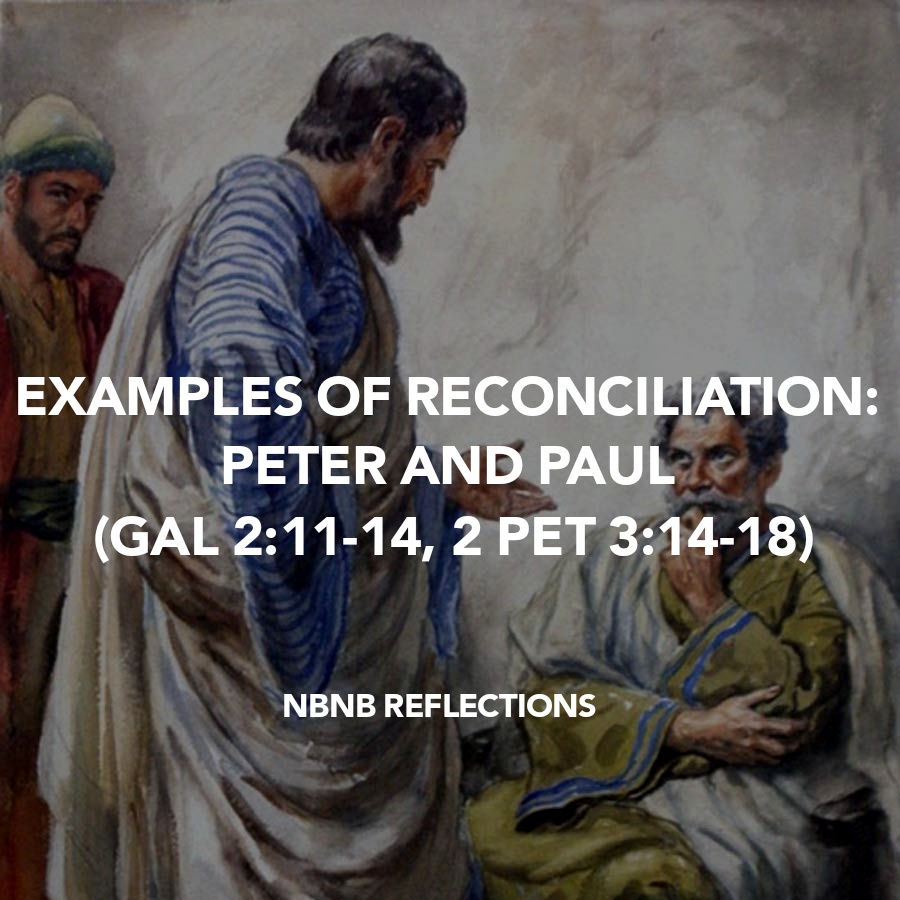
EXAMPLES OF RECONCILIATION: PETER AND PAUL (GALATIANS 2:11-14, PETER 3:14-18)
The theme for our reflection is “Examples of Reconciliation: Peter and Paul” Paul expressed his displeasure at Peter or Cephas for acting hypocritically and against the Gospel, however they continued work together as Apostles. We shall espouse the following fact as Paul’s criticism of Peter’s hypocrisy.
1. Diplomacy is needed in preaching and reception of the Gospel.
2. Hypocrisy kills diplomatic initiatives and adversely affects the reception of the Gospel by non-Christians.
First, Paul employed diplomacy in building relationships with the Gentiles in order to effectively communicate and preach the Gospel to them. One of the ways he employed diplomacy is to prove that although Jews and Gentiles have nothing in common, Paul ate and associated with the Gentiles and encouraged other Apostles to do same, it is for this reason in Galatians 2:12 he saw nothing wrong with Peter eating with the Gentiles in Antioch. To demonstrate the importance of diplomacy Paul wrote in 1 Corinthians 9:21-23 that “To those outside the law I became as one outside the law (not being outside the law of God but under the law of Christ) that I might win those outside the law. To the weak I became weak, that I might win the weak. I have become all things to all people, that by all means I might save some. I do it all for the sake of the gospel, that I may share with them in its blessings.” Beloved in the Lord, diplomacy is needed in preaching the Gospel because it is one of the ways to penetrate the culture of others and effectively communicate the Gospel to its recipients. Diplomacy helps to communicate to the recipients of the Gospel from another cultural background that the preacher of the Gospel respects and accepts their way of life or culture and does not seek to condemn their culture or be judgemental. Diplomacy does not mean participating in every cultural practice but it means reaching out to the recipients of the Gospel in a tactful, respectful manner while remaining sensitive to his or her cultural identity. Sometimes diplomacy is needed in reaching out to those in the world of darkness. We must be ready to eat with them, walk with them, be empathetic towards them even as we preach the Gospel and allow the Holy Spirit to convert or transform them. For us to be in good relationship with those who are different from us in terms of religion, culture and political ideology we must adopt diplomacy. Peter failed to employ diplomacy when dealing with the gentiles, hence, Paul rebuked him. This may have led to a disagreement between the two parties although Peter was senior to Paul in terms of the Apostolic call and ministry. Sometimes our approach to ministry and how we handle unbelievers and others from different culture although they may be believers may become the source of disagreement among us as believers but let us always ask the question, what would Jesus do in this situation or how will Jesus relate to others who are culturally different from us? Paul is convinced that the Gospel we preach is a Gospel of love and non-discrimination which welcomes all and sundry to Jesus. Any approach or conduct short of this amounts hypocrisy.
Secondly, hypocrisy kills diplomatic initiatives and adversely affects the reception of the Gospel by non-Christians or believers. It is for this reason Paul expressed his displeasure at Peter’s hypocrisy, “For before certain men came from James, he was eating with the Gentiles; but when they came he drew back and separated himself, fearing the circumcision party. And the rest of the Jews acted hypocritically along with him, so that even Barnabas was led astray by their hypocrisy. But when I saw that their conduct was not in step with the truth of the gospel, I said to Cephas before them all, “If you, though a Jew, live like a Gentile and not like a Jew, how can you force the Gentiles to live like Jews?” (Galatians 2:12-14). Hypocrisy in preaching the Gospel does not enable the recipients of the Gospel to trust and accept the preacher as one who truly loves them and desires their welfare and salvation. Hypocrisy is pretending to love others yet in our hearts it is not the case. How can we preach the Gospel if we are not ready to embrace the recipients of the Gospel? Jesus, employed diplomacy and love by walking and eating with those considered to be sinners. After Jesus had called Levi, the tax collector to become His disciple, He went home with him “…as he reclined at table in his house, many tax collectors and sinners were reclining with Jesus and his disciples, for there were many who followed him. And the scribes of the Pharisees, when they saw that he was eating with sinners and tax collectors, said to his disciples, “Why does he eat with tax collectors and sinners?” And when Jesus heard it, he said to them, “Those who are well have no need of a physician, but those who are sick. I came not to call the righteous, but sinners.” (Mark 2:15-17) Dear friend, hypocrisy will not enable us to effectively preach the Gospel, today many Churches and Christians have built a tall wall around themselves to the exclusion of those who are still in the world of sin and darkness. The Church must breakdown the self-righteous and hypocritical walls that Peter and the other Jews had erected in Antioch and in the spirit of diplomacy and love, embrace the Gentiles of our time who are the drug addicts and prostitutes on the street and the lost and perishing in our society. Until there is a radical revival and change in our ways of doing things in the church with regards to Mission and Evangelism we cannot make impact in the world as it was done by Jesus Christ and later Paul and the other Apostles. We have been called to call others, make it a point as a Christian to preach Gospel by sometimes employing diplomacy in reaching out to others. Let us eschew any form of hypocrisy in our approach to those in the world. Peter later understood the importance of Paul’s teachings and principles with regards to mission of the Lord and commended in 2 Peter 3:15, “Bear in mind that our Lord’s patience means salvation, just as our dear brother Paul also wrote you with the wisdom that God gave him.” It also meant that Peter and Paul might have had their differences in the past with regards to their approach to issues but they agreed on teachings of the Scripture and worked together. Peter was part of the first Apostles appointed yet he listen to the counsel of Paul and respected his wisdom. This is a great lesson to us, the Lord can use our subordinates, juniors or other people we may be higher than in rank to correct or counsel us. Senior ministers can also receive counsel from junior ministers and the laity can also offer useful admonishment to the clergy because the Holy Spirit is not limited when it comes to believers He desires to use to achieve God’s purpose. We must not be antagonistic and vindictive when we are counseled or corrected by others. We should rather be thankful and reconcile with them and work towards achieving a common goal and mission for the Lord.
In conclusion, we have discovered two important facts for our consideration. One, diplomacy is needed in the preaching and reception of the Gospel and two, hypocrisy kills diplomatic initiatives and adversely affects the reception of the Gospel by non-Christians. We must therefore be willing to listen to godly wisdom and counsel when we are going wayward or engaged in acts that will be a barrier to others who may be willing to come to Jesus and be saved.
PRAYER
When was the last time you made a friend for the purpose of preaching the Gospel to him and her? What is your approach to those who are considered to be worldly people? Are all your friends Christians? What about those who are not Christians, have you considered them to be prospects worth considering as friends for the purpose of winning them for Christ? Pray for the Holy Spirit to grant you discernment, love and the diplomacy needed in reaching out to others who are still beyond the walls of salvation.
Holy Spirit, strengthen us to eschew any form of hypocrisy and help us to embrace all manner of people through diplomacy so that through our outreach they will be transformed by the power of the Gospel. Amen.





 NO BIBLE NO BREAKFAST DAILY BIBLE REFLECTIONS AND MORE
Leave a comment