

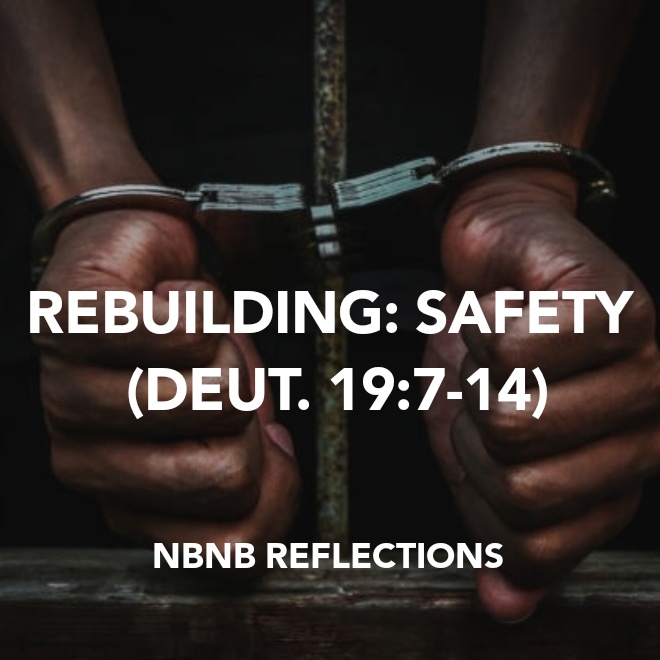
REBUILDING: SAFETY (DEUTERONOMY 19:7-14)
REFLECTION
“Rebuilding: Safety” is the theme for our reflection. Rebuilding connotes reconciliation or the restoration of a broken relationship in a context where a person has unintentionally or without malicious intent taken the life of a close relative. Safety in the context of our theme is the asylum granted to a person who has committed murder unintentionally to prevent him or her from an avenger of blood. We shall reflect on the fact that believers and for that matter family members of a victim of murder must forgive and reconcile with the culprit when investigations prove that he or she caused the death unintentionally or without malice aforethought. Again, even in instances where the accused is found guilty or convicted of the crime of murder and is dealt with by the law, we must forgive and pray for him or her. This is the test of our faith and understanding of the teachings of Scripture and the Words and examples of our Lord Jesus Christ.
Beloved in the Lord, will you rebuild a relationship with the murderer who unintentionally caused the death of your husband, wife, sibling or children? As part of the laws given to the Israelites as they prepared to settle on the promised land, one of the commandments was to set side cities that would serve as asylum for people who commit murder unintentionally so that they are protected from the avenger of blood. “This is why I command you to set aside for yourselves three cities. 8 If the LORD your God enlarges your territory, as he promised on oath to your ancestors, and gives you the whole land he promised them, 9 because you carefully follow all these laws I command you today—to love the LORD your God and to walk always in obedience to him —then you are to set aside three more cities. 10 Do this so that innocent blood will not be shed in your land, which the LORD your God is giving you as your inheritance, and so that you will not be guilty of bloodshed. (Deuteronomy 19:7-10). In our dispensation, we may not have specialised cities dedicated to innocent killers. A person who kills without the intention to do so is an innocent killer. For instance, your child suddenly crosses a moving vehicle without notice and is accidentally knocked down by a driver who had no intention of knocking him or her down or to killing him. If after the investigations, it is proven that he is not guilty of the crime of murder or he never had the intention to kill your child, would you forgive him or harbour bitterness and hatred against him for the rest of your life? This is the crux of our reflection. In giving the law, God has taken into consideration the fact that as human beings, there could be situations where events may happen beyond our control which would have fatal consequences or irreparable damage to others. The question is, should the unintentional offender’s life be equally taken as a form of restitution or appeasement? “This is the rule concerning anyone who kills a person and flees there for safety—anyone who kills a neighbor unintentionally, without malice aforethought. 5 For instance, a man may go into the forest with his neighbor to cut wood, and as he swings his ax to fell a tree, the head may fly off and hit his neighbor and kill him. That man may flee to one of these cities and save his life. 6 Otherwise, the avenger of blood might pursue him in a rage, overtake him if the distance is too great, and kill him even though he is not deserving of death, since he did it to his neighbor without malice aforethought. (Deuteronomy 19:4-6) This means that the law concerning “an eye for eye” in Leviticus 24:19-21,which states that “Anyone who injures their neighbor is to be injured in the same manner: 20 fracture for fracture, eye for eye, tooth for tooth. The one who has inflicted the injury must suffer the same injury. 21 Whoever kills an animal must make restitution, but whoever kills a human being is to be put to death” is not absolute unless the person is proven guilty.
It is significant to note that, Criminal law has two important elements that must be proven before a person is found guilty and sentenced for a crime. These elements are the actus reus and the mens rea. The actus rea means evil or guilty mind. The guilty mind or intention is reflected in words such as intentionally, knowingly, willfully recklessly, maliciously purposely, and negligently committing a prohibited act. The prosecution must prove that at the time of committing the forbidden or prohibited act, the accused person had an evil or guilty mind to kill the victim. In addition, the Actus reus which is the guilt act must be proven by the prosecution. The prosecution must prove that the accused person engaged in a positive act or an omission which is prohibited by law or considered a crime. Both the guilty mind and the guilty act must be proven at the same time to constitute a crime. The absence of one of the elements is not sufficient to convince the court to sentence the person. However, when the two elements are present or proven, the person will be found guilty of the crime and sentenced. This is where the Law given to the Israelites reflects or resonates with modern Criminal Law. We see the elements of mens rea and actus reus relevant when it comes to the Criminal law given to the Israelites. “But if out of hate someone lies in wait (Mens rea/guilty mind, evil intention), assaults and kills a neighbour (Actus reus/guilty act, prohibited act), and then flees to one of these cities, 12 the killer shall be sent for by the town elders, be brought back from the city, and be handed over to the avenger of blood to die. 13 Show no pity. You must purge from Israel the guilt of shedding innocent blood, so that it may go well with you. (Deuteronomy 19:11-13)
Dear friend in the Lord, even in instances where a close relative is murdered and the law has to deal with the culprit, it is required of us as believers to forgive the murderer and pray for him or her just as Jesus prayed for us on the cross when He said “Father, forgive them, for they do not know what they are doing.” (Luke 23:34). Paul further explains Jesus’ teachings on forgiveness when he wrote ” Do not repay anyone evil for evil. Be careful to do what is right in the eyes of everyone. 18 If it is possible, as far as it depends on you, live at peace with everyone. 19 Do not take revenge, my dear friends, but leave room for God’s wrath, for it is written: “It is mine to avenge; I will repay,” says the Lord. (Romans 12:17-19) In other words, whether the person is innocent or not we are required to forgive and pray for him or her. This is one of the most challenging teachings of Christianity which is linked to pleasing God and doing His will. We have no choice but to trust and obey through the enablement of the Holy Spirit.
In summary, we have discovered that believers and for that matter family members of a victim of murder must forgive and reconcile with the culprit when investigations prove that he or she caused the death unintentionally or without malice aforethought. Again, even in instances where the accused is found guilty or convicted of the crime of murder and is dealt with by the law, we must forgive and pray for him or her. This is the test of our faith and understanding of the teachings of Scripture and the examples of our Lord Jesus Christ.
PRAYER
Holy Spirit, grant us the strength in our most painful and sorrowful moments to forgive and reconcile with those whose unintentional actions or omissions take away the people we cherish most. Again, grant us the grace to forgive and pray for those who intentionally or maliciously take the lives of the people we cherish even as they are dealt with by the law. Amen.





 NO BIBLE NO BREAKFAST DAILY BIBLE REFLECTIONS AND MORE
Leave a comment