

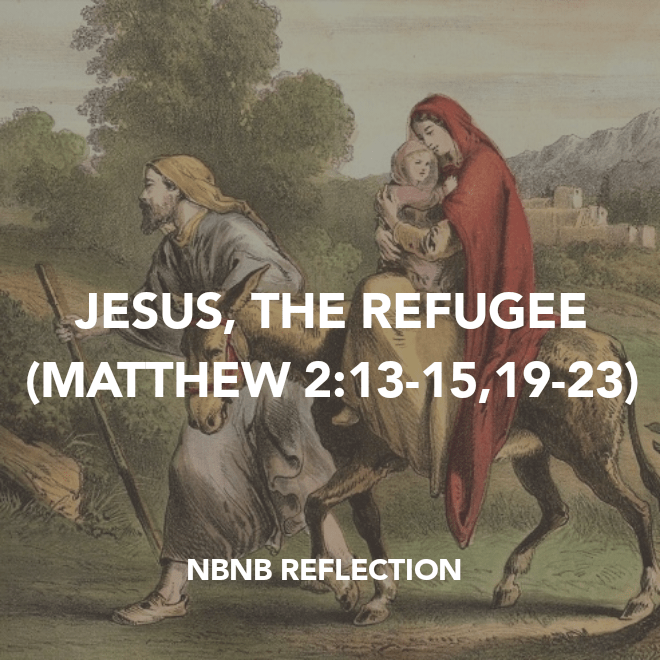
JESUS, THE REFUGEE (MATTHEW 2:13-15, 19-23)
REFLECTION
“Jesus, the Refugee” is the theme for our reflection today. By definition, a refugee is an individual who has been compelled to leave their country due to war, persecution, or natural disaster. It is a title that carries the weight of displacement, yet it is a title that our Lord Himself wore.
When the envious and malicious Herod sought to murder Jesus—perceiving the infant as a threat to his earthly kingship—the Angel of the Lord intervened. Joseph was directed to flee with the baby Jesus and Mary to Egypt.
“Now when they had departed, behold, an angel of the Lord appeared to Joseph in a dream and said, ‘Rise, take the child and his mother, and flee to Egypt, and remain there until I tell you, for Herod is about to search for the child, to destroy him.’ And he rose and took the child and his mother by night and departed to Egypt and remained there until the death of Herod. This was to fulfil what the Lord had spoken by the prophet, ‘Out of Egypt I called my son.’” (Matthew 2:13-15)
This narrative serves as a powerful reminder: if it is not yet our time to exit this world, God will always provide a means of escape according to His divine purpose for our lives. To survive and fulfil His mission on earth, the Saviour of the world had to become a refugee.
Dear friend, we must pause to consider that Jesus was once a refugee in Africa—specifically, Egypt. He was targeted as a political threat and forced into exile. Because of this, Jesus understands the profound pain and frustration that refugees endure. He has ever walked in those shoes.
A refugee is inherently vulnerable, living as a foreigner in a land where they must seek asylum. How, then, would Jesus have us treat those who find themselves in the same position today? The answer is found in the “Golden Rule”:
“…in everything, do to others what you would have them do to you, for this sums up the Law and the Prophets.” (Matthew 7:12)
In the book of Leviticus, the Israelites were commanded to treat foreigners with dignity: “The foreigner residing among you must be treated as your native-born. Love them as yourself, for you were foreigners in Egypt. I am the LORD your God.” (Leviticus 19:34a)
Furthermore, Jesus assures those who treat the displaced with love and respect:
“Then the King will say to those on his right, ‘Come, you who are blessed by my Father; take your inheritance… For I was hungry and you gave me something to eat, I was thirsty, and you gave me something to drink, I was a stranger, and you invited me in…’” (Matthew 25:34-35). We must eschew hostility and, as true disciples of Christ, embrace a spirit of hospitality and kindness toward strangers and refugees.
Another vital lesson is that life may lead us to places we never anticipated living or working. Yet, we must trust the Lord to provide and bring His will to pass, regardless of our geographical location or uncomfortable circumstances. After Herod’s death, an angel directed Joseph to return to Israel. However, fearing Archelaus, Joseph withdrew to the district of Galilee and settled in a small, insignificant town called Nazareth (Matthew 2:19-23). This fulfilled the prophecy that He would be called a Nazarene.
The grace of God is not limited by postcodes. Nazareth was so overlooked that Nathanael famously asked, “Nazareth! Can anything good come from there?” (John 1:46). Yet, the presence of Jesus transformed Nazareth forever. It became the home of the greatest man to ever walk the earth—the one who performed unprecedented miracles and offered humanity the gift of salvation.
Do not be discouraged by your “Nazareth” tag. Do not let a humble beginning or a challenging family background define your future. Do not lose hope in your current situation. You are destined for greatness! Your contemporaries may be shocked by your progress and ask, “Is this not the carpenter’s son?” God does not look at the insignificance of your background. If you maintain a covenant relationship with Him through Jesus Christ, you will rise to greatness even from the most unlikely places. As Jesus assures us, “With man this is impossible, but with God all things are possible.” (Matthew 19:26).
A PRAYER
Heavenly Father,
We thank You for the life of Your Son, Jesus Christ, who understood what it meant to be a stranger in a foreign land. We pray for all refugees and displaced persons today; may they find safety, dignity, and a warm welcome.
Lord, we also lift up our own “Nazareths” situations—those areas of our lives that feel small, hopeless, or insignificant. We thank You that Your power is not limited by our circumstances. Grant us the faith to keep trusting You and the strength to keep working hard, knowing that You are with us. Transform our humble beginnings into a testimony of Your greatness.
In Jesus’ name, Amen.




 NO BIBLE NO BREAKFAST DAILY BIBLE REFLECTIONS AND MORE
Leave a comment