

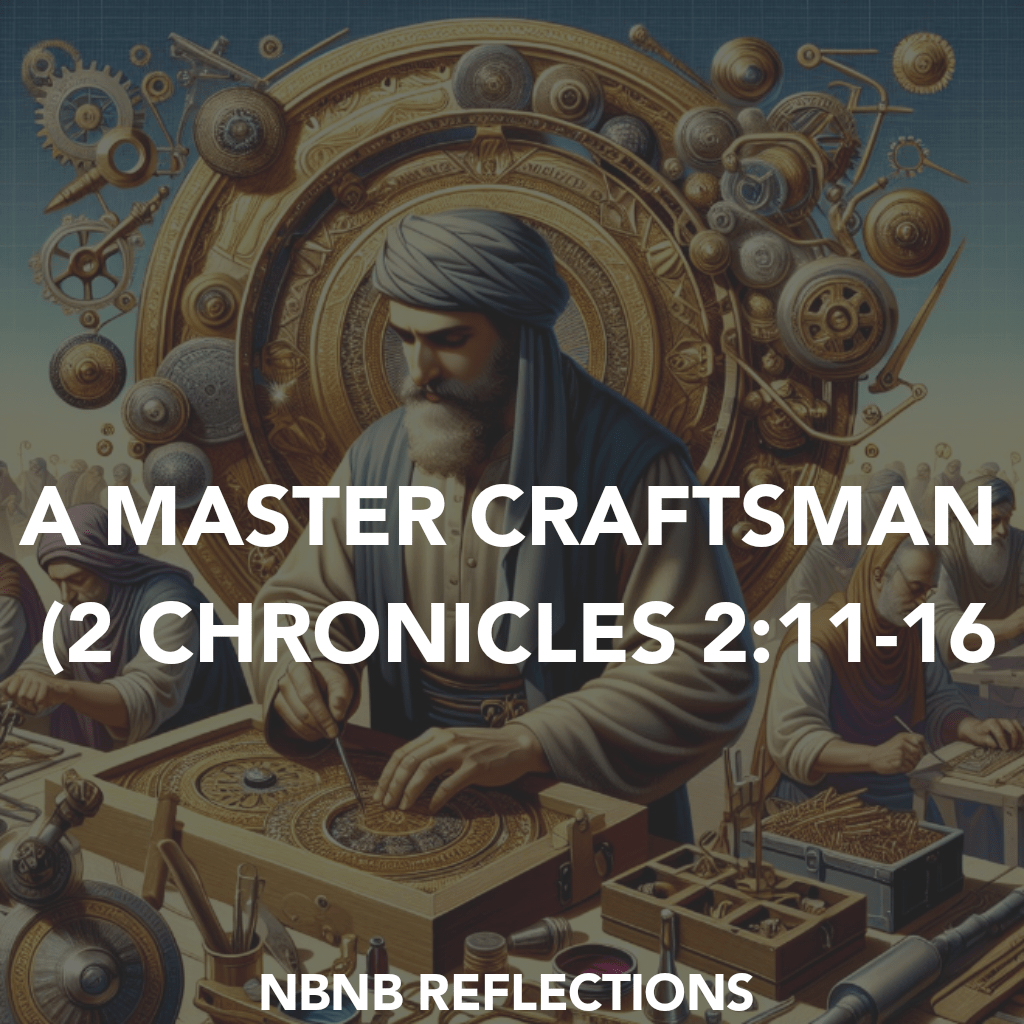
A MASTER CRAFTSMAN (2 CHRONICLES 2:11-16)
REFLECTION
The theme for our reflection is “A Master Craftsman”. A craft is an activity involving skill in making things by hand and a master craftsman is a general title for someone experienced and highly skilled in a particular craft. We shall reflect on the fact that leadership is essential in scouting and identifying human resources for the Lord’s Mission. When King Solomon became King, he set out to fulfil his father’s desire of building a temple for the Lord. It was for this reason he wrote to the King of Tyre, ” “Send me, therefore, a man skilled to work in gold and silver, bronze and iron, and in purple, crimson and blue yarn, and experienced in the art of engraving, to work in Judah and Jerusalem with my skilled workers, whom my father David provided.” (2 Chronicles 2:7). 2 Chronicles 2:11-16 is the reply from the King of Tyre to King Solomon entering into a contract with him to provide a master craftsman and materials needed for the building of the temple and the palace.
Beloved in the Lord, it is instructive to note that church leadership plays an important role in identifying or putting together human resources and logistics to further God’s mission. King Solomon specifically wrote to the King of Tyre because he wanted to enter into a contract with him for a master craftsman and materials for the building of a magnificent Temple for the Lord and a palace for his administration. Hiram king of Tyre replied by letter to Solomon, “… “I am sending you Huram-Abi, a man of great skill, 14 whose mother was from Dan and whose father was from Tyre. He is trained to work in gold and silver, bronze and iron, stone and wood, and with purple and blue and crimson yarn and fine linen. He is experienced in all kinds of engraving and can execute any design given to him. He will work with your skilled workers and with those of my lord, David your father. (2 Chronicles 2:13-14) Dear friend in the Lord, leaders can only achieve their purpose or be successful if they are supported with the required human resources. King Solomon had skillful men in Israel to build the Temple yet he wrote to the King of Tyre “7 “Send me, therefore, a man skilled to work in gold and silver, bronze and iron, and in purple, crimson and blue yarn, and experienced in the art of engraving, to work in Judah and Jerusalem with my skilled workers, whom my father David provided.” (2 Chronicles 2:7). Why would King Solomon request assistance from a pagan King to provide a pagan master craftsman to help build a temple for God? The key lesson is that as Church leaders we must be open-minded and realise the fact that sometimes the best human resource or skilful professionals we need to build our places of worship or other facilities of interest may come from other places or people beyond our church or religion. God has endowed all humanity with talent and the gift of creativity. These gifts are not limited to believers alone. There are master craftsmen and experts who are Muslims, Traditionalists and Buddhists. We are not compelled to use the human resources available to us even if they do not possess the requisite or advanced knowledge or expertise required for our purpose.
The skilful craftsmen or workers in the church must not feel undermined when it becomes necessary to collaborate or work with other persons from outside the church because of their unique talent, craftmanship or expertise. In the end, we learn from others to better our trade or skills. Sometimes, artisans or craftsmen in the church become agitated when Church leaders bring in expert or highly skilled master craftsmen to facilitate the progress of existing projects. King Solomon did not request for a revival master craftsman but one that had special skill and knowledge to work with his skilled men. This is the importance and role of leadership in development. Today, we see how developed nations strategically make use of highly skilled professionals from underdeveloped and developing nations for their infrastructure and economic development. A good and efficient leader is one who can identify challenges or deficiencies in the system and can recruit or provide competent human resources to overcome the challenges. A good and efficient leader must not be nepotistic but be open-minded and ready to work with anyone who is qualified and has what it takes to fulfil the objectives in the strategic plan laid down by the organization. In light of the above lesson, non-Christians who are experts can be consulted or contracted by the church to fulfil the infrastructural needs of the church.
In summary, we have discovered that leadership is essential in scouting and identifying human resources for the Lord’s mission. May our leaders be empowered to fulfil God’s will for the church and the nation. Shalom.
PRAYER
Holy Spirit grant our Church leaders discernment and wisdom to identify and make use of the needed human resources for the growth of the Church and expansion of Your mission. Amen.




 NO BIBLE NO BREAKFAST DAILY BIBLE REFLECTIONS AND MORE
Leave a comment