

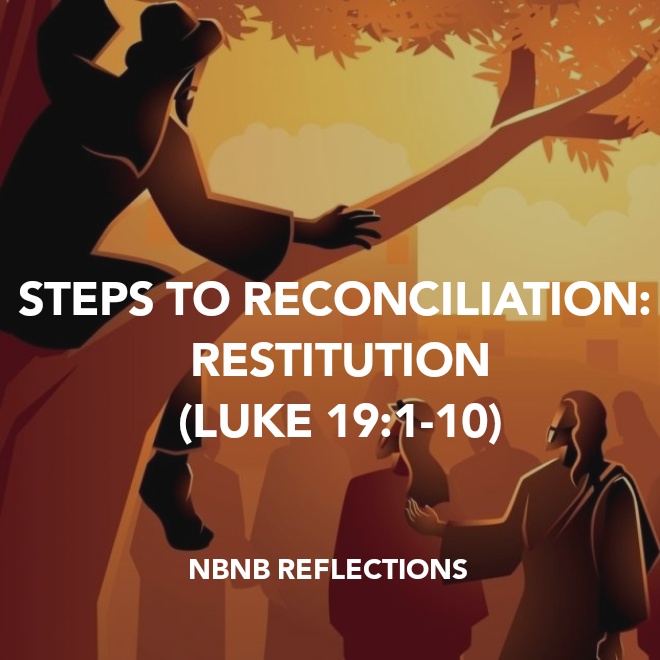
STEPS TO RECONCILIATION: RESTITUTION (LUKE 19:1-10)
REFLECTION
“Steps to reconciliation: Restitution” is the theme for our reflection. Restitution is the act of giving back to a person something that was lost or stolen. It also means compensating a victim for the loss incurred as a result of the offender’s actions. In other words, restitution is the act of an offender compensating a victim or restoring the victim as much as possible to the state he or she was in before suffering the loss or pain. We shall examine the fact that restitution is the outward demonstration of one’s willingness to make amends and be reconciled to the victim of his or her wrongful act or omission. However, it is important to note that restitution may not be possible or required in some situations before forgiveness and reconciliation take place.
Dear friend, restitution is the visible sign of an offender’s readiness to make amends or seek reconciliation with the person he or she has offended by restoring, replacing or compensating him or her for the loss that had been occasioned as a result of the offender’s wrongful act or omission. After encountering Jesus Christ, Zacchaeus demonstrated an outward sign of repentance when he declared that he would compensate or restore to everyone whatever money he had ever taken from them unlawfully. Zacchaeus stood up and said to the Lord, “Look, Lord! Here and now, I give half of my possessions to the poor, and if I have cheated anybody out of anything, I will pay back four times the amount.” (Luke 19:8). Dear friend, restitution is the non-verbal means of saying “I have deeply offended you, I am sorry, please forgive me and accept this gift as a visible sign of my apology and a restoration or replacement of what I unlawfully took from you in the past” When Jesus saw that Zacchaeus had demonstrated a remarkable sign of remorse, confession and repentance through an act of restitution, He assured Zacchaeus of God’s forgiveness and reconciliation when He said to him, “Today salvation has come to this house, because this man, too, is a son of Abraham. 10 For the Son of Man came to seek and to save the lost.” (Luke 19:9-10). We are greatly encouraged to be repentant and, if possible, offer restitution to those we have offended. It pleases God and those we have offended when we demonstrate visible and commendable signs of remorse and repentance through an offering of restitution.
Restitution is usually relevant in situations where an item or money has been stolen from the victim, or a situation where a person takes a loan from a friend but refuses to pay for an unreasonable duration of time upon several requests for the repayment of the loan. Again, restitution is relevant in a situation where a guarantor has been arrested or made to pay the loan of the person he or she stood in for. Restitution is also important when we are duty-bound but fail to perform our obligations to a person, and as a result of that failure, the person suffers a loss, injury, or harm. In brief, restitution is important in the reconciliation process if we have contributed to causing an unfavourable or injurious event or situation in someone’s life and later seek to reconcile with the person. It is important to note that although restitution may take place in some situations, it may not adequately compensate the victims of our actions or omissions, especially where death has occurred or where a person has suffered emotional and irreparable bodily harm as a result of our actions or omissions. Nonetheless, the intention behind the restitution is of utmost importance. It communicates to the victim that although the restitution may not be wholly adequate to compensate him or her, the offender is equally remorseful, repentant, and willing to be forgiven and reconciled with the offended party.
Dear friend in the Lord, another important question is, can we forgive and reconcile with those who have offended us without restitution? The answer is yes. The fact is that some people may offend us, but cannot afford the restitution. In other words, we may offend people and genuinely seek their forgiveness and reconciliation, but may not have the means to offer restitution to them. When Joseph’s brothers came to ask for forgiveness, they offered no restitution, yet He forgave them and said to them, “Don’t be afraid. Am I in the place of God? 20 You intended to harm me, but God intended it for good to accomplish what is now being done, the saving of many lives. 21 So then, don’t be afraid. I will provide for you and your children. ” And he reassured them and spoke kindly to them.” (Genesis 50:19-21). Sometimes, we, those who mediate or facilitate the reconciliation process between people, may be required to support the offenders in the payment or offering of restitution. This was what Paul sought to do on behalf of Onesimus when he wrote to Philemon to forgive Onesimus. Paul wrote, ” So if you consider me a partner, welcome him as you would welcome me. 18 If he has done you any wrong or owes you anything, charge it to me. 19 I, Paul, am writing this with my own hand. I will pay it back…” (Philemon 1:17-19). Most importantly, when we offended God, we never paid any restitution to Him before He forgave us and reconciled with us, thus “… God demonstrates his own love for us in this: While we were still sinners, Christ died for us. (Romans 5:8). We are greatly encouraged to follow God’s example, in that, whether the offender provides restitution or not, we must be ready to forgive and reconcile with him or her. It takes unconditional love to forgive, especially when the one who has hurt you is unable to provide restitution. We are greatly admonished by Jesus when He said, “A new command I give you: Love one another. As I have loved you, so you must love one another. 35 By this everyone will know that you are my disciples, if you love one another.” (John 13:34-35). This unconditional love must be demonstrated at all times, even when it becomes emotionally hard for us to forgive those who have hurt us greatly in the past or present. Remember, you may not always receive restitution from an offender, but we always have the power to forgive and reconcile with the offender to the glory of God and according to His will.
In summary, we have discovered that restitution is the outward demonstration of one’s willingness to make amends and be reconciled with the victim of his or her wrongful act or omission. It is important to note that although confession and repentance are important elements in the process of reconciliation, restitution is not, because it may not be possible or required in some situations before forgiveness and reconciliation take place. Whether or not restitution is offered by the repentant offender, we are greatly required to follow the example of our Lord Jesus, although we never provided any restitution for our sins, He saved us and said, “Father, forgive them, for they do not know what they are doing.” (Luke 23:34). Let us go out there and do the same as disciples of our Lord Jesus Christ. Shalom.
PRAYER
Holy Spirit, empower us to follow the perfect example of our Lord Jesus Christ to always forgive and seek reconciliation even in the absence of restitution. Amen.





 NO BIBLE NO BREAKFAST DAILY BIBLE REFLECTIONS AND MORE
Leave a comment