

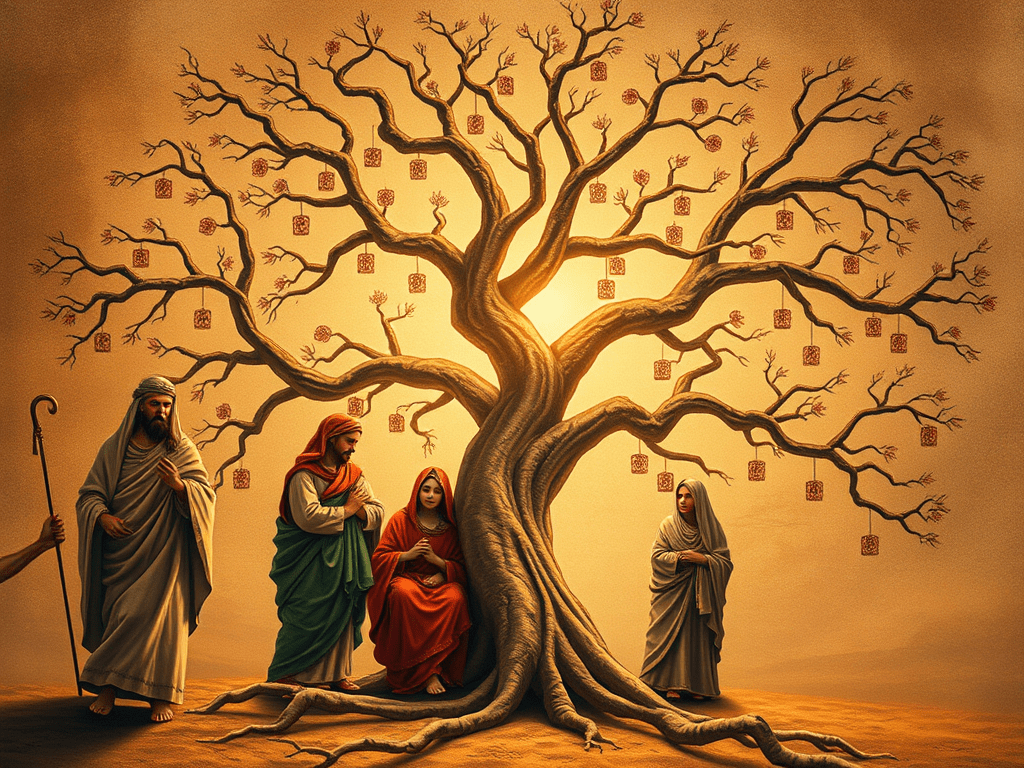
WHO IS WHO?
A Sermon on Matthew 1:1–17
Introduction
Every family has a story. Some families proudly talk about their background. Others try to hide certain names and events. When people ask, “Who is who?” they are really asking important questions:
Who truly matters? Who carries authority? Who defines the story?
When Matthew begins his Gospel, he does something unexpected. He does not start with a miracle. He does not begin with Jesus preaching. He does not even tell us about His birth immediately. Instead, Matthew starts with a genealogy – a long list of names.
Why would Matthew do this?
Because before you understand what Jesus did, you must understand who Jesus is. Matthew wants his readers to know from the very beginning that Jesus did not appear by accident. He came through history, through promises, through broken families, and through God’s faithful plan.
Matthew 1:1-17 is not just a list of names. It is a message. It tells us that Jesus’ identity is rooted in God’s covenant, and it shows us how God works through real people – saints and sinners, Jews and Gentiles, men and women, kings and ordinary people – to fulfill His purpose.
So today, we ask the same question: Who is who?
And Matthew answers clearly: Jesus is the Christ, and God brings unlikely people into His great story.
Jesus’ True Identity (Matthew 1:1)
Matthew opens with these words:
“The book of the genealogy of Jesus Christ, the Son of David, the Son of Abraham.” In one sentence, Matthew gives us Jesus’ true identity.
First, His name is Jesus, which means “The Lord saves.” This tells us His mission. Jesus did not come to gain political power or human applause. He came to save. Our hope, therefore, is not in governments, wealth, or human leaders, but in Jesus, the One who saves.
Second, Matthew calls Him Christ, which means Messiah. This tells us that Jesus is not just a teacher or prophet. He is the promised Deliverer Israel had been waiting for. Our faith rests on a Savior sent by God, not on a man chosen by people.
Third, Jesus is called the Son of David. This speaks of kingship. Jesus has the legal right to rule. He is the true King. When we follow Jesus, we are not following advice, we are submitting to a King.
Finally, Jesus is the Son of Abraham. This connects Him to God’s covenant promise that all nations would be blessed through Abraham. This means the Gospel is not limited to one group. No one is outside God’s plan. Jesus came for the whole world.
God Uses Imperfect People (Matthew 1:2–6)
As Matthew lists the names, some of them surprise us.
We meet Tamar, whose story is full of pain and scandal. Her life shows brokenness, yet God did not erase her name. This teaches us that God can redeem even the most difficult family situations.
We see Rahab, a Gentile woman and a former prostitute. She had a past, but she also had faith. God brought her into the line of the Messiah. This reminds us that your past does not cancel God’s purpose for your future.
Then there is Ruth, a foreign widow. She was an outsider who trusted God. Through her, God shows us that He welcomes those society often rejects.
Matthew also mentions Bathsheba, calling her “the wife of Uriah,” reminding us of David’s great moral failure. Matthew does not hide Israel’s sins. Instead, he shows us that God’s grace is greater than human failure.
These names teach us something powerful: God does not wait for perfect people. He works through broken lives to bring about His perfect plan.
God Works Through History (Matthew 1:6–11)
The genealogy then moves through Israel’s kings. Some were faithful. Many were not. From David to Solomon, we see greatness mixed with failure. Even the best leaders fell short. This reminds us that only Jesus is the perfect King.
As the list continues, we see good kings and bad kings. Obedience and rebellion appear side by side. Yet through it all, God’s promise continues. Human failure does not stop divine purpose.
Then comes the exile to Babylon, one of the darkest moments in Israel’s history. It looked like the end. But even judgment could not destroy God’s plan. This teaches us that your worst season is not your final chapter. God is still at work.
God Brings Hope Out of Obscurity (Matthew 1:12–16)
After the exile, many of the names are unfamiliar. These were not famous people. They were ordinary individuals living quiet lives.
This shows us that God does not depend on fame. He often works through simple families and unknown people. You do not need to be popular or powerful for God to use you.
Matthew carefully says that Joseph was the husband of Mary, not the biological father of Jesus. This protects the truth of the virgin birth. Jesus is legally the son of David, but divinely the Son of God.
Matthew ends this section by saying, “Of Mary was born Jesus, who is called Christ.” This reminds us that Jesus’ birth was miraculous and intentional. And just as His birth was supernatural, so is the salvation He offers.
God Designs History With Purpose (Matthew 1:17)
Matthew then summarizes the genealogy into three groups of fourteen generations. This shows order and design. God is not random. He works with purpose.
The Hebrew name David is written as:
דָּוִד (Dāwīd)
Each letter has a numerical value:
ד (Dalet) = 4
ו (Vav) = 6
ד (Dalet) = 4
4 + 6 + 4 = 14, So, David = 14.
Thus, 14 became a symbolic “David number.” This is why Matthew 1 structures Jesus’ genealogy into three sets of 14 generations:
Abraham → David (14)
David → Exile (14)
Exile → Christ (14)
So, Matthew is making a theological statement, not just a historical one that: Jesus is the true Son of David and that the Davidic promise has reached its fulfillment in Him.
Thus, Matthew wants us to see that Jesus stands at the centre of history.
From promise, to kingdom, to exile, to restoration – God carried the story all the way to Christ. This teaches us that God finishes what He starts.
What Does This Teach Us About “Who Is Who?”
First, Jesus is the true “Who.” The genealogy points not to human greatness but to God’s Son.
Second, those the world rejects, God includes. Women, Gentiles, sinners, and outsiders all appear in Jesus’ family line.
Third, your story matters to God. If God used Tamar, Rahab, Ruth, and Bathsheba, He can use you.
Fourth, God is in control of history. From Abraham to Jesus, He never lost track.
Finally, our true identity is found in Christ. The most important question is not, “Who is your family?” but “Are you in Christ?”
Conclusion
Matthew begins his Gospel with a genealogy to show us that Jesus has the right name, the right lineage, the right authority, and the right mission. God’s plan moves through ordinary and broken people, proving that no one is beyond His grace.
So when we ask, “Who is who?” the answer is clear:
Jesus is the Christ, and in Him, we belong in God’s story.
Prayer
Father in Heaven,
Thank You for sending Jesus, the Son of David and the Son of Abraham, to save us.
Thank You for using imperfect people and reminding us that our past does not define our future.
Help us to find our identity in Christ, trust Your purposes, and live as part of Your divine story.
Use our lives to bring glory to Your name.
In Jesus’ mighty name, Amen.




 NO BIBLE NO BREAKFAST DAILY BIBLE REFLECTIONS AND MORE
Leave a comment