
REFLECTION
The theme “Unity is Hopeful” carries a profound message for the modern believer. To understand it, we must look at the key words. “Unity” is the state of being joined together as a whole, moving with a singular purpose. “Hopeful” describes a feeling of optimism or a grounded expectation that something good is about to happen. When we combine them, we find that our collective strength is the very thing that fuels our confidence in the future.+1
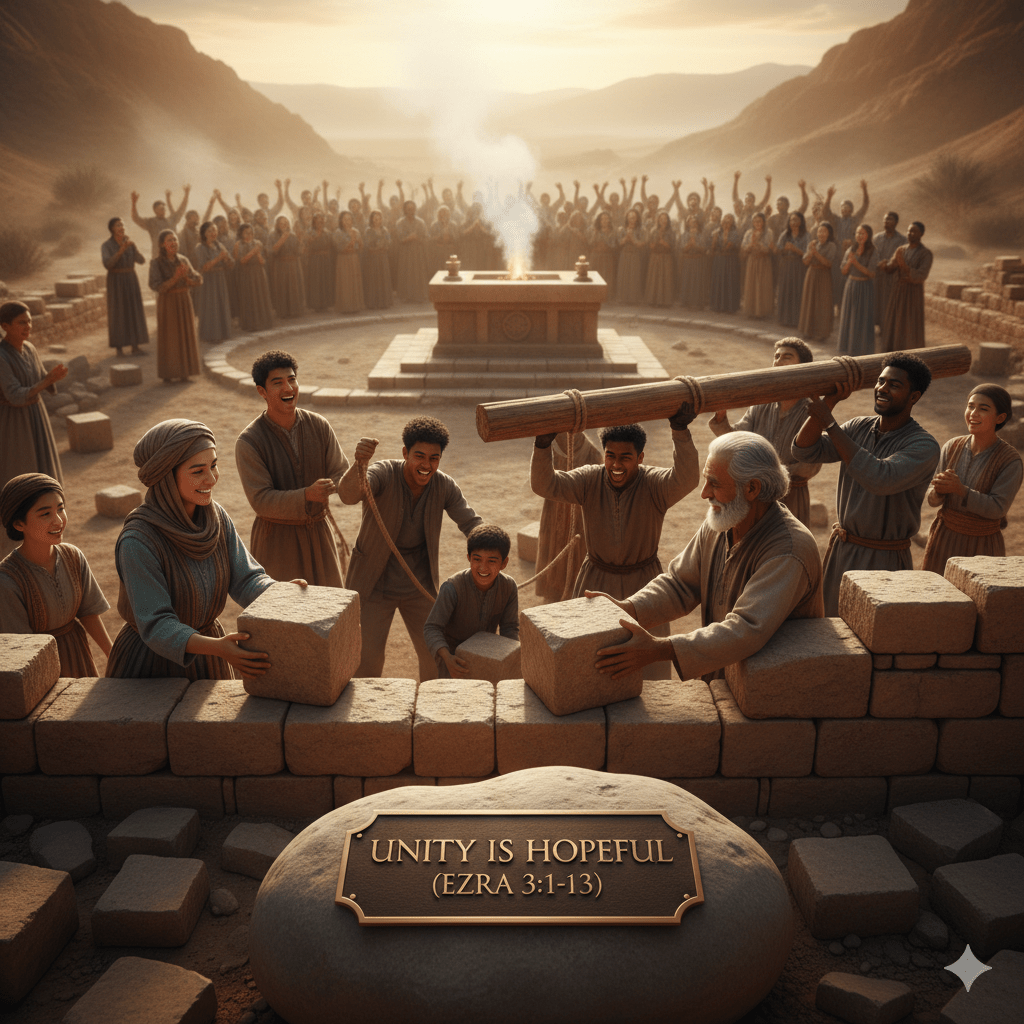
The Book of Ezra tells the story of God’s faithfulness to His people after seventy years of exile in Babylon. It records their return to Jerusalem to rebuild the temple, which had been destroyed. In Ezra 3:1-13, we find the remnant of Israel standing among ruins, yet they are not discouraged. The background to this text is one of new beginnings; they have survived the judgment of exile and are now laying the foundation for a new era. The key lessons from this passage are the necessity of unified worship, the strength found in collective labour, and the power of shared emotional honesty.+1
The Power of Unified Worship
The first key lesson is that hope begins when a community prioritises God with one heart. In Ezra 3:1, the Bible records that “when the seventh month came and the Israelites had settled in their towns, the people assembled together as one man in Jerusalem.” This phrase “as one man” is vital. It suggests that thousands of individuals acted with a single soul. Before they built houses for themselves, they built an altar to God. Even though they were surrounded by enemies, their unity in worship gave them the courage to continue. As the text says, “Despite their fear of the peoples around them, they built the altar on its foundation and sacrificed burnt offerings on it to the Lord” (Ezra 3:3).+1
In the 21st century, the church often faces external pressures or “fear” from a world that is increasingly indifferent to the Gospel. When a congregation is divided by petty arguments, hope fades. However, when we come together in prayer and worship, we find a strength that defies our circumstances. This echoes the promise in Matthew 18:20: “For where two or three gather in my name, there am I with them.” Practical hope is found when we stop focusing on our differences and start focusing on our shared Altar—Jesus Christ.
The Strength of Collective Labour
The second lesson is that unity makes the impossible task of “rebuilding” possible. Reconstructing a temple from rubble was a massive physical and financial undertaking. Ezra 3:7 notes that “they gave money to the masons and carpenters, and gave food and drink and olive oil to the people of Sidon and Tyre.” Everyone contributed what they had. This was not a one-man show; it was a movement of the entire community. Ezra 3:9 highlights this cooperation: “Jeshua and his sons and brothers and Kadmiel and his sons… joined together in supervising those working on the house of God.”+1
For Christians today, this is a call to service. Whether a church is trying to launch a community food bank, renovate a building, or spread the Gospel in a digital age, it requires “joined together” supervision and effort. No single member has all the gifts. As 1 Corinthians 12:12 reminds us, “Just as a body, though one, has many parts, but all its many parts form one body, so it is with Christ.” When we work together, the burden becomes light, and the “hope” of seeing a finished project becomes a reality.
Harmony in Shared Emotions
Finally, we learn that unity does not mean everyone feels the same way, but that everyone moves in the same direction. When the foundation of the temple was finally laid, there was a great noise. The younger generation shouted for joy because they saw a future, but the older generation wept because they remembered the beauty of the first temple. “No one could distinguish the sound of the shouts of joy from the sound of weeping, because the people made so much noise. And the sound was heard far off” (Ezra 3:13). Their unity was so strong that their different emotions blended into one powerful testimony to the surrounding nations.
In our modern churches, we often have generational gaps. The “hope” of the church is found when we allow space for both the “shouts” of the young and the “tears” of the old. We must be a people who can “rejoice with those who rejoice; mourn with those who mourn” (Romans 12:15). When we validate each other’s experiences while staying committed to the same foundation, our witness becomes “heard far off” by those who are looking for a place to belong.
Conclusion
In summary, Ezra 3:1-13 teaches us that unity is the engine of hope. By assembling “as one man,” prioritising worship, contributing resources together, and holding space for one another’s emotions, the Israelites turned a pile of stones into a place of promise.
My call to action for you is this: identify one area in your local church or community where there is division. Make it your mission this week to be a bridge-builder. Whether through a kind word, a shared task, or a joint prayer, choose to act “as one” with your brothers and sisters. Hope is not a solo sport; it is a team effort.
Prayer
“Heavenly Father, we thank You for the record of Your faithful people in the Book of Ezra. We ask that You would pour out a spirit of unity upon Your church today. Help us to gather ‘as one man’ to seek Your face. Remove the walls of pride and division that hinder our progress. May our combined worship and work be a sign of hope to a broken world. Strengthen our hands for the tasks ahead. In Jesus’ name, Amen.”





Leave a comment