

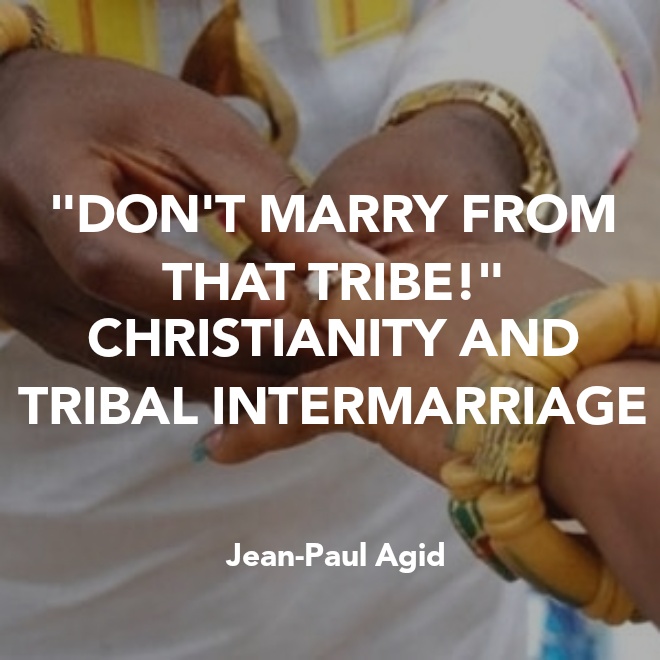
As a pastor, I once counselled a youth who was furious with her parents because they insisted that she marries from their tribe. She was bent on marrying the love of her life who was from another ethnic group but her parents vowed not to support her marriage if she insisted on marrying the said man who came from their perceived rival ethnic group.
Some ethnic groups in Africa and for that matter Ghana are very particular about their choice of marriage partners. Parents from a particular ethnic group or tribe would insist that their children marry from their ethnic group or tribe. The question for our consideration is should Christians practice the phenomenon of choosing a marriage partner on the basis of ethnic or tribal affiliation?
Fundamentally, the phenomenon of selecting a mate based on ethnic or tribal identity has been with the human race from time immemorial. We shall recall that when it was time for Isaac to marry, Abraham insisted that Isaac’s wife is chosen from his tribe. We are told that “Now Abraham was old, well advanced in years. And the LORD had blessed Abraham in all things. 2 And Abraham said to his servant, the oldest of his household, who had charge of all that he had, “Put your hand under my thigh, 3 that I may make you swear by the LORD, the God of heaven and God of the earth, that you will not take a wife for my son from the daughters of the Canaanites, among whom I dwell, 4 but will go to my country and to my kindred, and take a wife for my son Isaac.” (Genesis 24:1-4). One may argue that, perhaps Abraham did not want Isaac to marry a Canaanite woman because they were pagans. Such an argument may not be convincing because apart from Abraham who had a covenant with God we are not made aware that any other person among his kindred had a relationship with God. We may safely conclude that the argument of pagan influence does not surface in Abraham’s choice of a spouse for Isaac, because Rebekah and the rest of Abraham’s kindred were still pagans until she was taken as a wife for Isaac. In Abraham’s case, he strongly felt that a wife from his tribe will be best for his son, Isaac. It could be that he detested the cultural practices of the Canaanites and would have nothing to do with them.
It is important to mention that, after Israel was liberated from Egypt, part of their laws prohibit them from marrying pagans. This had nothing to do with tribal sentiment or ethnocentric stereotypes. The choice of mate selection was purely on the basis of religion. The Israelites were instructed, You shall not intermarry with them, giving your daughters to their sons or taking their daughters for your sons, 4 for they would turn away your sons from following me, to serve other gods. (Deuteronomy 7:3-4). Samson’s parents were very familiar with this law therefore when he wanted to marry a Philistine, “his father and mother said to him, “Is there not a woman among the daughters of your relatives, or among all our people, that you must go to take a wife from the uncircumcised Philistines?” But Samson said to his father, “Get her for me, for she is right in my eyes.” (Judges 14:3). We can safely conclude that, generally, the Israelites were prohibited from marrying people from other tribes because of pagan influence. There were examples of Israelites who married from other tribes but kept their faith and religion intact without any pagan influence. For instance, Joseph married an Egyptian woman. “Before the years of famine came, two sons were born to Joseph by Asenath daughter of Potiphera, priest of On. (Genesis 41:50). Esther also married a Persian pagan King, Ahasuerus, “the king loved Esther more than all the women, and she won grace and favour in his sight more than all the virgins, so that he set the royal crown on her head and made her queen instead of Vashti. (Esther 2:17) We realise that even if the Israelites marry from another ethnic group, they were not to give up their religion and faith. Whiles in exile they were not to intermarry but marry their own and reproduce. Jeremiah told the Israelites in Babylonian that ““Thus says the LORD of hosts, the God of Israel, to all the exiles whom I have sent into exile from Jerusalem to Babylon: 5 Build houses and live in them; plant gardens and eat their produce. 6 Take wives and have sons and daughters; take wives for your sons, and give your daughters in marriage, that they may bear sons and daughters; multiply there, and do not decrease. (Jeremiah 29:4-6) So far, we have noticed that the major reason for God disallowing intermarriage between the Jews and other ethnic groups is because of their idol worship or paganism. King Solomon suffered the ramification of marrying pagan women from other ethnic groups without holding firmly to his faith “For when Solomon was old his wives turned away his heart after other gods, and his heart was not wholly true to the LORD his God, as was the heart of David his father. 5 For Solomon went after Ashtoreth the goddess of the Sidonians, and after Milcom the abomination of the Ammonites. 6 So Solomon did what was evil in the sight of the LORD and did not wholly follow the LORD, as David his father had done. (1 Kings 11:4-6). It must, however, be noted that a person who became a proselyte (a person who has converted from another religion to another) was found to be worthy of marriage by the Jews because they also believed in the same God as the Jews. For instance, Ruth, a Moabite became a Jew after she lost his first Jewish husband and followed her mother-in-law and her religion. Ruth said to Noami, her Jewish mother-in-law, “Do not urge me to leave you or to return from following you. For where you go I will go, and where you lodge I will lodge. Your people shall be my people, and your God my God. (Ruth 1:16) Even though Ruth was a Moabite by birth she became a Jewish proselyte and was married by Boaz, a Jew. “Boaz took Ruth, and she became his wife” (Ruth 4:13)
When we come to the New Testament, Paul admonished the Church of Corinth, “Do not be unequally yoked with unbelievers. For what partnership has righteousness with lawlessness? Or what fellowship has light with darkness? 15 What accord has Christ with Belial? Or what portion does a believer share with an unbeliever? 16 What agreement has the temple of God with idols? For we are the temple of the living God; (2 Corinthians 6:14-16) Again we see paganism as the main reason for rejecting a prospective partner who may come from an ethnic group which is different from yours. Paul, however, adopts a more tolerant approach to a spouse who is an unbeliever when he wrote that “To the rest I say (I, not the Lord) that if any brother has a wife who is an unbeliever, and she consents to live with him, he should not divorce her. 13 If any woman has a husband who is an unbeliever, and he consents to live with her, she should not divorce him” (1 Corinthians 7:12-13). The ideal situation is for believers to marry other believers no matter their ethnic background or tribe, however, we are not encouraged to divorce our partners because they have become unbelievers.
Most of the reasons Christian parents give to their children to prohibit them from marrying people of other tribes are stereotypical and not based on religion or faith. A stereotype is a widely held but fixed and oversimplified image or idea of a particular type of person or people. Examples of stereotypes are Anlo men from the Volta region of Ghana are stingy, Fante women are extravagant in their use of money, Ga women are disrespectful, Dangomba men are abusive, and Ashanti men are unfaithful. Unfortunately, these generalised and ethnic stereotypical views are strongly held by some Christian parents and they are used to disqualify the prospective partners of their children. The lesson we draw from Scripture is that we should not be concerned about the tribe or ethnic background of a person when it comes to marriage but as Christians, we should be more concerned about the religion of the person. Instead of asking the question, “where does he or she come from? we should rather be more concerned about the question, “is he or she a believer or faithful Christian?
Why is it important for a believer to marry another believer? The answer is obvious, to avoid any unwholesome influence that will defile or tempt us to via off our salvation in Christ Jesus. Being a believer is an important consideration when choosing a spouse because it concerns our destiny.
In summary, we have examined the thorny issue of Christianity and Tribal intermarriage. We have attempted to journey through Scripture to see if we shall have a strong reason for selecting a spouse based on ethnic and tribal considerations or stereotypes. We have discovered that although the Israelites were instructed to marry from their own nation and ethnic group, the fundamental reason was for them to keep their faith undefiled by pagan influence. It means that if a pagan becomes a proselyte he would be considered worthy of marriage. Similarly, Christians are greatly encouraged to choose marriage partners based on their faith or religion as Christians but not based on their ethnic or tribal backgrounds. Again, Christians are not to select partners based on ethnic or tribal stereotypes. So long as the person is a Christian or disciple of Christ, it is fine. The standard for selecting a prospective spouse is “Is he or she a believer or has he or she accepted Jesus Christ as his or her Lord and Saviour? If yes, then he or she is worthy of consideration, if no, then either the person becomes a Christian or you look elsewhere. When you wish to defy the odds and go ahead to marry an unbeliever then you must be sure that you are firmly rooted in your faith and will not be influenced by your unbelieving spouse. Then again, the question arises, what will be the fate of your children if your unbelieving spouse, especially, the unbelieving husband prevents the children from following your religion? I hope this reflection would help us appreciate and respect other people’s ethnic groups or tribes even as we focus only on the faith or religion of a person we are considering for marriage. Shalom.






 NO BIBLE NO BREAKFAST DAILY BIBLE REFLECTIONS AND MORE
Leave a reply to Jean-Paul Agidi Cancel reply