

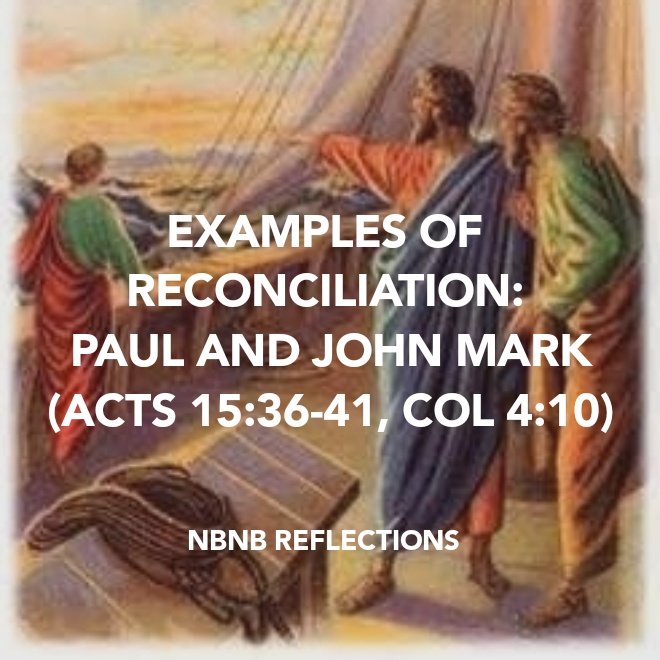
EXAMPLES OF RECONCILIATION: PAUL AND JOHN MARK (ACTS 15:36-41, COLOSSIANS 4:10)
REFLECTION
“Examples of Reconciliation: Paul and John Mark ” is the theme for our reflection. Reconciliation is the restoration of a broken relationship marred with division and resentment. We shall reflect on the fact that as servants of the Lord, we must avoid tension by speaking in a manner that will better manage existing issues of separation even as we work towards reconciliation. In other words, we have the will to avoid division by reconciling with one another.
Beloved in the Lord, we have the will to cause or avoid division wherever we find ourselves and to seek reconciliation. Tension and conflict may happen wherever there is a gathering of two or more people, but the people involved have the will to either allow the tension or conflict to lead to division or take decisive steps to manage the tension or conflict leading to reconciliation, peaceful coexistence and cooperation. We are told by Luke in Acts 15:36-40 that “Sometime later Paul said to Barnabas, “Let us go back and visit the believers in all the towns where we preached the word of the Lord and see how they are doing.” Barnabas wanted to take John, also called Mark, with them, but Paul did not think it wise to take him, because he had deserted them in Pamphylia and had not continued with them in the work. They had such a sharp disagreement that they parted company. Barnabas took Mark and sailed for Cyprus, but Paul chose Silas and left. (Acts 15:36-40). We are not told why John Mark deserted or separated from Paul and Barnabas in Pamphylia, but it is obvious Paul did not want anything to do with John Mark so long as their next missionary activity was concerned Barnabas, on the other hand, had a different opinion, he felt strongly that even though John Mark deserted them in Pamphylia, he should be given another opportunity to join them on their missionary journey. Unfortunately, Paul and Barnabas could not come to an amicable resolution to their disagreement, hence, they had to go their separate ways. Dear friend, Paul was the one who reported on the divisive conduct of John Mark, however in reporting on the conduct of John Mark, He did it in such a way that Barnabas was not pleased with his approach. Barnabas had to put up a defence on behalf of John Mark. This defence was not acceptable to Paul, hence their disagreement leading to division. It is important to acknowledge the fact that Paul and Barnabas were not on their own mission, they were on the mission of Jesus Christ therefore Paul should have exercised discretion in reporting on John Mark’s earlier conduct to avoid tension given that Barnabas perhaps may have had a very good relationship with John Mark. Paul could have reported the issue in a manner that would have invited John Mark or given Him a chance to meet them for a brotherly conversation about his conduct while encouraging him to have the mission at heart. In other words, Paul could have proposed that if Barnabas insisted John Mark should go with them then they should invite John Mark for a meeting with them and speak to him as brothers and co-workers about his conduct in Pamphylia. We always have the will to cause or avoid division through the way we handle tension and conflicts. It takes all the parties to be willing to compromise their stand and enter into a negotiation having the organization and mission they stand for in mind.
Regardless of our differences in Church, family and workplace, we must always understand that we are ambassadors of Christ, therefore, we must follow the steps Jesus taught us in resolving issues with those who have offended us “If your brother or sister sins, go and point out their fault, just between the two of you. If they listen to you, you have won them over. But if they will not listen, take one or two others along, so that ‘every matter may be established by the testimony of two or three witnesses.’ If they still refuse to listen, tell it to the church; and if they refuse to listen even to the church, treat them as you would a pagan or a tax collector. (Matthew 18:15-17). In applying Jesus’ steps for conflict resolution, did Paul let Mark know about his conduct at Pamphylia? Did Mark refuse to listen to Paul? If Mark had refused to listen to Paul, did Paul take Barnabas or some other Christian worker along to resolve the issue before firmly taking the decision that Mark will not be allowed to follow them on the missionary journey? Dear friend, Jesus has taught us to pursue conflict resolution and reconciliation and if all attempts fail then division could be considered. It appeared Paul’s report about John Mark’s conduct was immediately followed by his decision to have him taken out from the rest of the missionary journey, Barnabas on the other hand disagreed with him. Beloved in the Lord, some people in our churches, family and workplaces are like John Mark, they will sometimes act in a way that will infuriate us and like Paul, we may want to cut them off and have nothing to with them but like Jesus Christ, who even gave Judas a chance to repent but he refused because of the love of money, let us not easily give up on people who offend us or disappoint us. Christians must be willing to sit down as brothers and sisters to amicably resolve issues, reconcile and journey together as one family spreading the Gospel of Christ and carrying out the mission of God in the world even as we await the second coming of our Lord Jesus Christ. It is important to note that Colossians 4:10 gives as an indication that Paul reconciled with John Mark when he wrote to the Church of Colossae urging them to welcome John Mar, “My fellow prisoner Aristarchus sends you his greetings, as does Mark, the cousin of Barnabas. (You have received instructions about him; if he comes to you, welcome him.)”. We must not allow division or entertain any form of tension that will prevent us from working together as servants of the Lord to subsist. We must take steps to dialogue and seek forgiveness and reconciliation.
In summary, We have discussed that as servants of the Lord, we must avoid tension by speaking in a manner that will better manage existing issues of separation even as we work towards reconciliation. In other words, we have the will to avoid division by reconciling with one another. May the Holy Spirit empower us to effectively manage our differences and conflicts in our churches, families, and workplaces even as we seek forgiveness and reconciliation as a better and permanent solution. Shalom
PRAYER
Dear friend, has someone offended you in your church, family, among your friends, or in your neighbourhood? Have you separated yourself from this person or person? For how long will you avoid the person or these people? Kindly pray to God to heal you emotionally to overcome the anger you have towards them. Again, pray for God to empower you and use you to initiate the process of reconciliation in mending the broken relationships in your life.
Almighty God, grant us the discernment and discretion to effectively manage tensions and conflicts in our Churches, workplaces and society so that the world will know that we are your children. May we follow the perfect example of Jesus in accommodating and working with others even with their differences and weaknesses. Amen.








Leave a Reply